What happens if the staple of mankind is changed?
Flour is a staple food. In fact, it is the primary staple for most of humanity.
What happens, then, when a staple food of a species - in this case, our own - is fundamentally altered?
If we consider degermination (as well as the removal of the bran) as a primary cause, our staple food has been lacking substances for about 160 years that regulate the entire! metabolism (fats, proteins, and carbohydrates). As if that weren’t enough, the nutrients within germ & bran support the function of the central nervous system, memory and concentration, the immune system, stress management, the ability to heal, genetic material and fertility, the structure and function of tissues, cells, nerves, skin, nails, and hair, and internal communication via biochemical messengers such as hormones, neurotransmitters, and so on - the list seems almost endless.
Thus, the degermination of flour has created a solid (though not the only) foundation for modern diseases of civilization. But let’s take it step by step; what are the…
… Known Ingredients of Grain Germ and Bran #
The Scientific Perspective #
From this viewpoint, the wheat germ consists of substances such as…
- Vitamins: Thiamin B1, Riboflavin B2, Niacin B3, Pantothenic acid B5, Pyridoxine B6, Folic acid B9 and Tocopherol E;
- Essential Minerals & Trace Elements: Calcium, Magnesium, Phosphorus, Potassium
- Essential Trace Elements: Iron, Zinc, Copper, Manganese, Selenium
- The essential amino acids Isoleucine, Methionine, Valine, Leucine, Phenylalanine, Tryptophan, Threonine and Lysine, Histidine, Tyrosine and Arginine are also considered essential for children and those recovering from illness
- Secondary amino acids: Alanine, Glycine, Proline, Serine, Cystine, Aspartic acid and Glutamic acid
- Saturated fatty acids: Myristic acid, Palmitic acid and Stearic acid
- Unsaturated fatty acids: Palmitoleic acid and Oleic acid
- The polyunsaturated Linoleic acid
- Spermidine
If we subject wheat bran to the same analysis, it consists of 50% fiber, 15% protein, 17% carbohydrates, and 5% fat, and additionally contains:
- the vitamins: Retinol A1, Thiamin B1, Riboflavin B2, Niacin B3, Pantothenic acid B5, Pyridoxine B6, Folic acid B9, Tocopherol E and Vitamin K
- the essential amino acids Threonine, Histidine, Isoleucine, Lysine, Phenylalanine, Tryptophan, Valine, Methionine, Leucine, Tyrosine and Arginine
- the essential minerals Magnesium, Phosphorus, Calcium, Potassium,
- the essential trace elements Sodium, Zinc, Magnesium, Manganese, Iron, Copper, Iodide, Selenium. So, the bran is gold as well. However, if you take these isolated substances and try to make them sprout -even if the proportions are followed with painstaking precision — what you get is: rancid mold. Something essential is missing from this list: Life. Since the scientific - analytical approach struggles with the phenomenon of life, we look at the germ and bran from the perspective of Traditional Chinese Medicine (TCM), rooted in Daoism. This view is not about “ingredients” but about qualitative effects - a completely different approach than that of modern science. Nevertheless, both are sciences.
The Perspective of Traditional Chinese Medicine (TCM) #
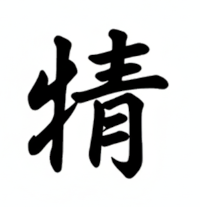
Here, the germ is seen as the seat of the essence, called Jing in Chinese.
In Western understanding, this essence is a paradox of matter and energy/information: it is both.
On one hand, Jing is material substance, comparable to genetic material and, consequently, the entire body. On the other hand, Jing is the living “substance” of the body, the life energy itself, whose preservation is the foundation for good health and longevity. As an essence, it holds and unites polarities in the form of adaptability (Yin) and resilience (Yang). If Jing is missing from the daily diet, the body consumes its own substance; life becomes arduous and sickly.
When the body is once again sufficiently supplied with Jing, a remarkable self-healing occurs - as far and as well as is still possible.
From a Daoist perspective, dying means that the Jing is running low; once it is exhausted, one simply is… no more. So Jing is kind of important.
Suspected Effects of Germ and Bran #
Both science and Traditional Chinese Medicine conclude that the germ is essential (meaning indispensable) for humans. Its absence must therefore be the cause of various ailments.
If essentials are missing from the daily diet, the body withers; life becomes burdensome and frail. If the body is resupplied with these essentials (before passing), a remarkable self-healing process begins.
From a scientific point of view, these substances are necessary for:
- The entire metabolism! (fats, proteins, and carbohydrates)
- The central nervous system, memory, and ability to concentrate
- The immune system, stress management, and the ability to heal
- Genetic material and fertility
- The structure and function of cells, nerves, tissues, skin, nails, and hair
- Internal communication via biochemical messengers such as hormones, neurotransmitters, etc.
The Difference Between Regular Flour and Goldkeim Flour #
The average Austrian supposedly consumes 0.24 kg of grain per day. In this scant quarter-kilo of grain, if Goldkeim flour were used instead of degerminated white flour, there would be seven grams of the aforementioned essential substances.
To be safe, let’s say it again: Seven grams per day.
This is equivalent to roughly 15 to 20 multivitamins per day - yet, even then, the high-quality fatty acids of the germ, the essential amino acids in their natural structure, the secondary plant metabolites (phytosterols, etc.), and the “living” quality would still be missing.
Seven grams per day! #
Seven grams per day adds up to ~2.5 kg of essentials per year. If 7g of essentials are missing every day, this is, from a medical perspective, a fundamental change for the organism. And it is an extraordinarily bad one.
If the scientific assumption is correct, it stands to reason that in the last ~100 years - simply due to the loss of essentials in our staple food - cardiovascular diseases, metabolic disorders, allergies, skin diseases, mental illnesses, stress, infertility, cancer, dementia, and autoimmune diseases must have increased.
To clarify whether this is the case or not is not the purpose of this website.
This website is intended to encourage you to eat Goldkeim flour instead of degerminated flour so that -
to mention it once again -
You feel better.
Whereby the absence of lifestyle diseases is, of course, a good explanation for a great feeling.
The Meaning of the Words Health & Illness #
Nutrition is a major factor in health and illness (and environmental protection, politics, species conservation, climate, a fairer world, and so on and so forth). Nutrition is an essential part of your own life as well as that of others, and accordingly, much is discussed, researched, written, and occasionally even known about healthy eating.
If you try to eat “healthily” while following all the contradictory therapeutic instructions, regulations, and sometimes laws, you might find that your life becomes exceptionally tedious. This could be because the term “health” is used — more or less intentionally — in different ways. However, there is one definition…
Health #
On July 22, 1946, health was defined in the Constitution of the World Health Organization (WHO) as:
“a state of complete physical, mental and social well-being and not merely the absence of disease or infirmity.”
As the only Western definition of health, it is accepted almost worldwide (191 out of 192 UN states).
This definition states that health includes physical and mental and social well-being (not “or” but “and”; all three areas are important!). According to this, we are all more or less “ill.”
Logically, this definition should be extended to include an intact ecosystem — because what use is health if there is no planet to inhabit?!
Illness #
The German word for illness, Krankheit, is etymologically derived from the Middle High German word gebrechen (“to lack,” “to break off”), which essentially means “it is missing.” Over time, the meaning shifted to “infirmity” or “illness.”
This definition sheds light on the omnipresent terms “civilization diseases” and “lifestyle diseases”:
There is a lack of both.
Interestingly, the English word “disease” describes the effect, while the German word describes the cause. The root of “disease” lies in the French desaise, meaning without ease. In other words: uncomfortable. Combining the two languages, we get:
Lack brings discomfort.
Well, look at that - who would have guessed!?
Since the essential parts are removed from flour, the resulting discomfort should be fundamental.
With that, the problem should be obvious - now to the solution.